Using commonMZ rules with CAMERA
Annotating adducts and fragments in an LC-MS peak table
Source:vignettes/camera-rules.qmd
CAMERA’s findAdducts() function needs a table of adduct and fragment rules: one row per rule, with columns name, nmol, charge, massdiff, oidscore, quasi, and ips. MZ_CAMERA() builds exactly that table from commonMZ’s curated adducts_fragments dataset.
The seven columns are defined as follows. name, nmol, charge, and massdiff are described in Kuhl et al. (2012); oidscore, quasi, and ips are documented only in the CAMERA source code.
| Column | Type | Meaning |
|---|---|---|
name |
character | Ion label (e.g. [M+H]+). |
nmol |
integer | Molecules per ion (1 = monomer, 2 = dimer). |
charge |
integer | Signed ion charge. |
massdiff |
numeric (Da) | Mass added by the adduct (compared to neutral mass) or lost as a neutral fragment. |
oidscore |
integer | Groups rules that share the same adduct formula but differ in nmol (e.g. [M+H]+ and [2M+H]+). CAMERA uses it to automatically extend a monomer match to the corresponding dimer/trimer hypotheses. |
quasi |
0 / 1 |
Mandatory ion flag. If no rule with quasi = 1 appears in a candidate group, CAMERA discards the whole group. Typically only the primary protonated ion carries quasi = 1. |
ips |
numeric |
Ion/adduct peak score (~0.25–1). Confidence weight per rule. When a peak fits multiple competing mass hypotheses, CAMERA sums ips within each group and discards the lower-scoring one. Typical values: 1.0 for [M+H]+, 0.5 for multiply-charged ions, 0.25 for neutral losses. |
Building the rules table
MZ_CAMERA() accepts three modes: "pos" for positive-ion LC-MS, "neg" for negative-ion LC-MS, and "ei" for electron-ionisation GC-MS. The warn_clash argument flags pairs of rules whose mass differences fall within a given ppm tolerance of each other and cannot be distinguished on mass alone.
Positive mode
rules_pos <- MZ_CAMERA(mode = "pos", warn_clash = TRUE, clash_ppm = 5)# A tibble: 2 × 2
first second
<chr> <chr>
1 [M+H-NH3]+ [M+NH4]+
2 [M+H-C3H4]+ [M+H+(CH3)2CO-H2O]+ (acetone cond.)
Consider removing one of them. Example:
rules=rules[ !grepl("[M+NH4]+",rules[,"name"],fixed=TRUE) ,]Browse the full table — sort any column or use the search box to filter by name or mass difference:
rules_pos %>% mutate(massdiff = round(massdiff, 4))Negative mode
rules_neg <- MZ_CAMERA(mode = "neg", warn_clash = TRUE, clash_ppm = 5)# A tibble: 2 × 2
first second
<chr> <chr>
1 [M-H-HCOOH]- [M-H+HCOOH]-
2 [M-H-C3H4]- [M-H+(CH3)2CO-H2O]- (acetone cond.)
Consider removing one of them. Example:
rules=rules[ !grepl("[M+NH4]+",rules[,"name"],fixed=TRUE) ,]
nrow(rules_neg)[1] 147Show code
rules_neg %>% mutate(massdiff = round(massdiff, 4))Electron ionisation (EI)
Show code
rules_ei <- MZ_CAMERA(mode = "ei", warn_clash = FALSE)The NH₄⁺ clash
A common clash in positive mode: [M+NH4]+ and neutral loss of NH₃ produce the same 17.027 Da difference and cannot be distinguished on mass alone. The warning from warn_clash = TRUE flags this. If NH₄⁺ adducts are rare in your matrix (common for many reversed-phase LC-MS setups), remove them before passing the rules to CAMERA:
rules_pos_clean <- rules_pos %>% filter(name != "[M+NH4]+")Annotating peaks: mm14 example
The example below uses mm14, the xcmsSet bundled with the CAMERA package (134 peaks, single sample, positive mode). For your own data, replace mm14 with your xcmsSet from xcms peak detection.
Step 1 — create an xsAnnotate object:
library(CAMERA)

data("mm14")
xsa <- xsAnnotate(mm14, polarity = "positive")
Step 2 — group co-eluting peaks by retention time window (FWHM-based):
xsaF <- groupFWHM(xsa, perfwhm = 0.6, intval = "into")For multi-sample data a cross-sample correlation step refines groups further:
xsaF <- groupCorr(xsaF, cor_eic_th = 0.7, pval = 1e-6,
                  calcIso = FALSE, calcCiS = FALSE, calcCaS = TRUE)
Step 3 — annotate isotope peaks:
xsaI <- findIsotopes(xsaF, ppm = 10, mzabs = 0.01, intval = "into")Step 4 — annotate adducts and fragments with commonMZ rules. CAMERA requires a plain data.frame, not a tibble, so wrap with as.data.frame():
cam_result <- findAdducts(xsaI,
                          ppm        = 10,
                          mzabs      = 0.01,
                          multiplier = 3,
                          polarity   = "positive",
                          rules      = as.data.frame(rules_pos_clean))
multiplier controls the highest oligomer CAMERA will consider (e.g. [2M+H]+, [3M+H]+). ppm and mzabs set the matching tolerance; CAMERA applies whichever window is wider, so for high-resolution data keep mzabs small (0.005–0.01) and rely on ppm.
Annotated peak table
getPeaklist() returns one row per feature with annotation columns appended. The adduct column shows the best-matching rule for each feature; features with no match are left blank. Features with the same pcgroup number are assumed to originate from the same parent molecule.
Show code
peaklist <- getPeaklist(cam_result)
peaklist %>%
  select(mz, rt, any_of(c("isotopes", "adduct", "pcgroup")), starts_with("sample")) %>%
  mutate(pcgroup = as.integer(pcgroup)) %>%
  arrange(pcgroup, mz) %>%
  mutate(mz = round(mz, 4), rt = round(rt, 1))
Which rules fired?
After annotation, count how often each rule was assigned. Rules that fired zero times are either absent from this matrix or could not be resolved within the tolerance.
We can make a simple pie chart:
Show code
camera_pie(cam_result)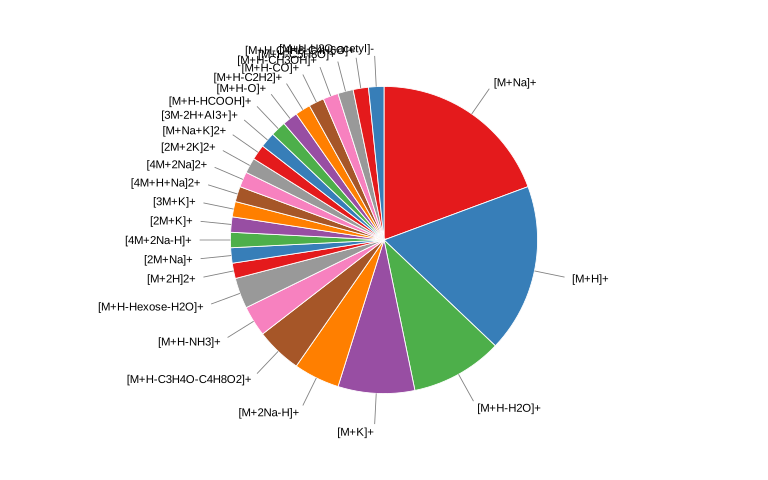
Or a fancy Sankey chart:
Show code
camera_sankey(cam_result)